
The last slide was not a summary. It was a safety instruction.
This morning, at the School of Health Sciences of the University of Leiria and Oeste, in Portugal, we taught a session to student occupational therapists: "RVer — Virtual Reality in the (re)habilitation of children through to older adults". Free, certified, organised by the aTOPlab — Assistive Technology and Occupational Performance Laboratory — together with the Occupational Therapy degree programme.
The room seats fifty. Sixty people came.
The slide that matters
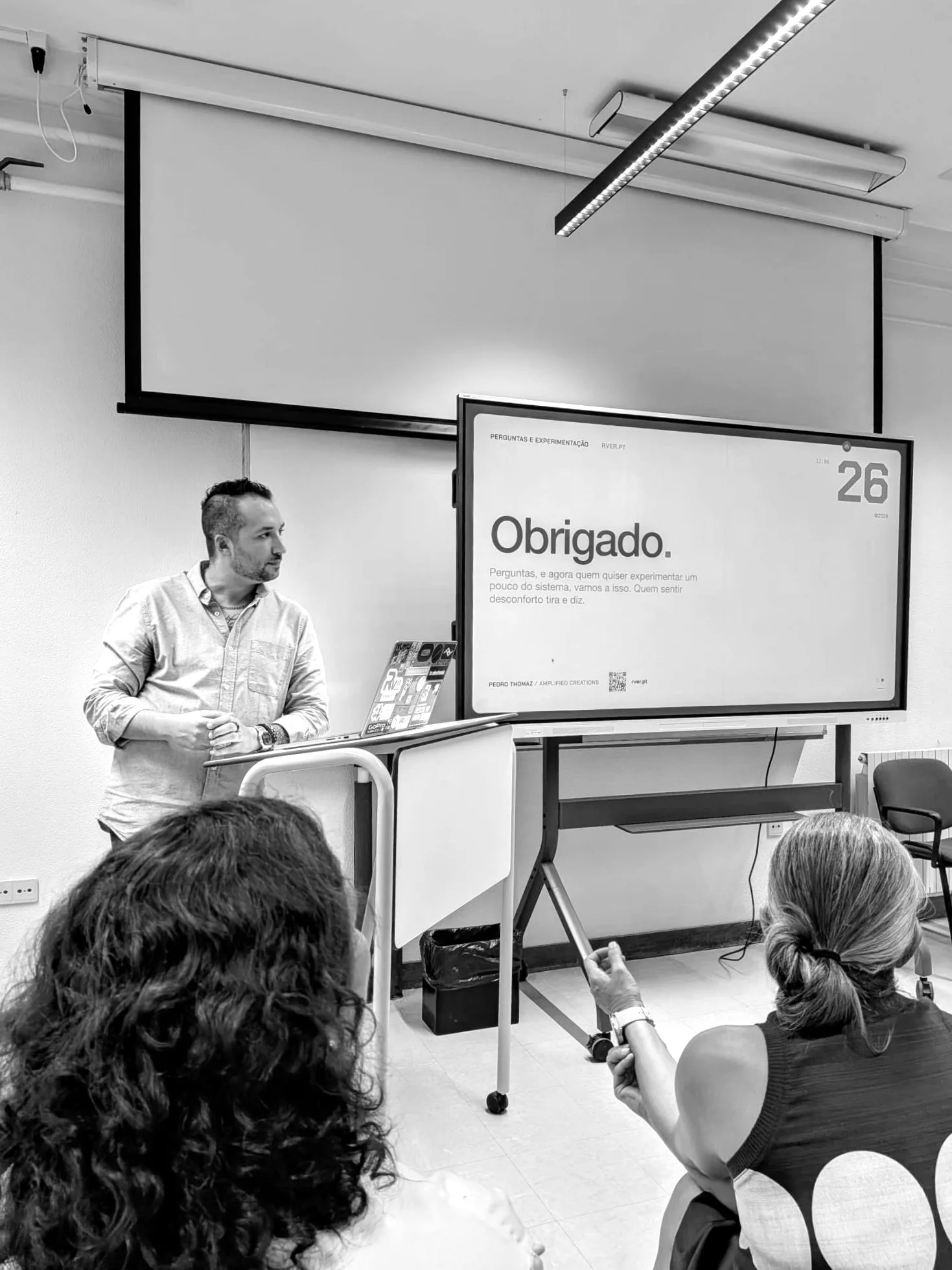
What it says, in Portuguese:
Questions — and now, anyone who wants to try a bit of the system, let's do it. If you feel any discomfort, take it off and say so.
Three decisions in two lines, and not one of them is marketing.
The demo comes last. First you explain what the thing is, where it fits, and what it does not do. Put the headset on someone first and they spend the rest of the session talking about the effect rather than the work.
Trying it is optional. In a room of sixty people there is always someone who would rather not, and nobody has to explain why.
If you feel discomfort, take it off and say so. That is the part most often left out. Someone wearing a VR headset cannot see the rest of the room and does not know whether interrupting is allowed — so you tell them, beforehand, that it is. In a lecture that is good manners. In a session with a patient it is clinical practice: comfort is not a detail of the experience, it is the first decision you make.
Why this happens in a health school
Because the person running an RVer session is not us. It is the clinical team.
The system is managed remotely, the content sits on the device, and a session runs without depending on an internet connection. None of that is the hard part. The hard part is the one software does not solve: choosing a scenario for one particular person, knowing when to stop, and fitting twenty minutes of session into a shift that is already full.
You learn that from people studying occupational therapy, and you teach it to the people about to practise it. Hence a session with the aTOPlab and the degree programme, rather than a sales pitch in a borrowed room.
The hospital is next door
Campus 5 is not the university's main site: it sits apart, directly across from Leiria Hospital.
In the palliative care service of ULS Leiria the system is used with patients — as SIC and the Jornal de Leiria both showed in 2024.
Teaching future therapists two hundred metres from the service where the system is already in use is not a pretty coincidence: it is the only way this does not end up as a technology in search of a problem. The people who will use it are across the street.
What a class like this gives us
Questions from the people who will use it.
Not the questions buyers ask — we know those already. These come from whoever will be holding the headset halfway through an afternoon, with one patient in front of them and another waiting. Each one is something to make simpler, and the list that comes out of a morning like this beats a week of guessing in an office.
This was the second time we took the system into an educational institution. The first was at ISLA Santarém, in June 2024. If there is a third, we will write that one up too.