i
Gym Room
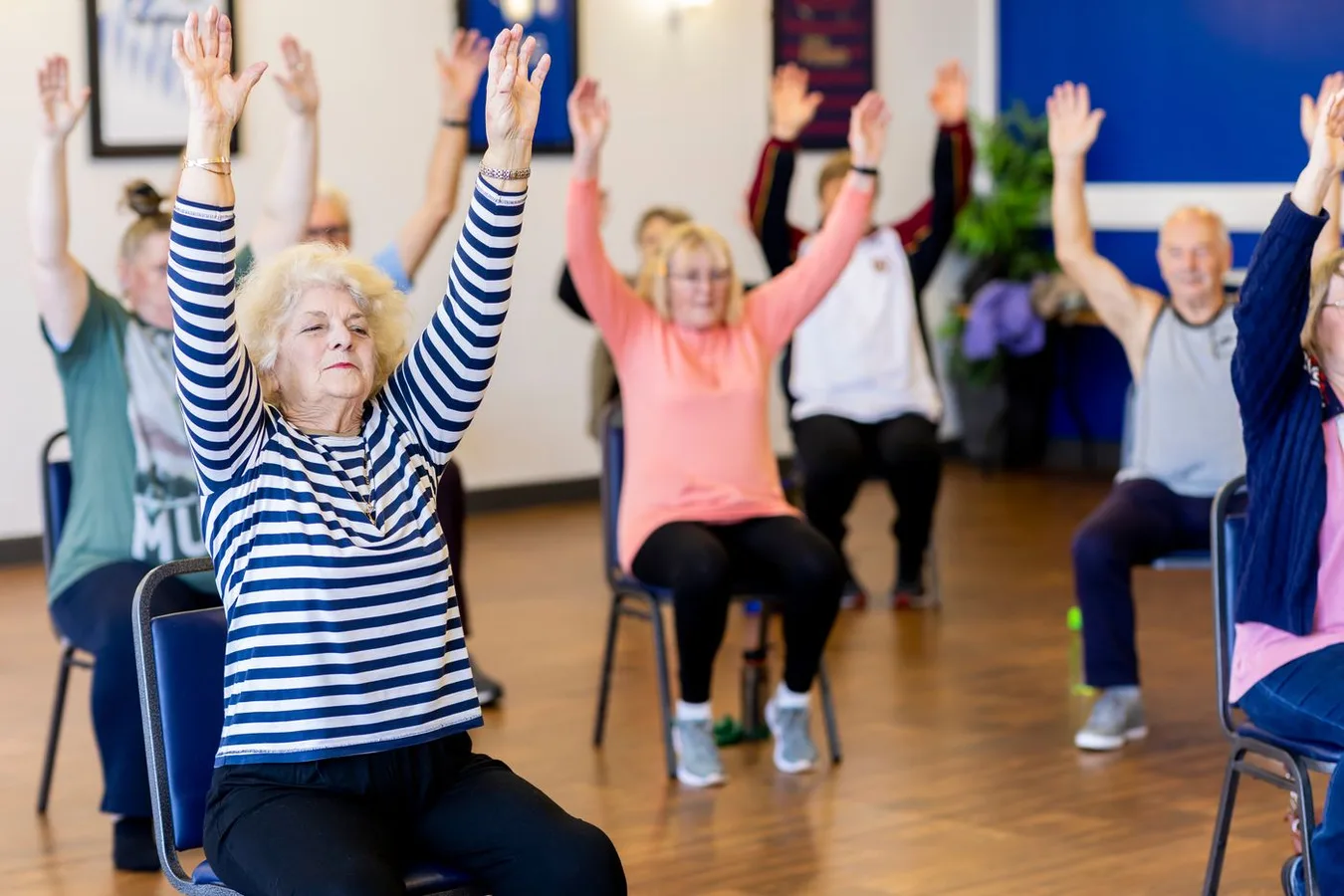
A calm 3D coach demonstrates each exercise (raises, stretches, shrugs, squats and warm-up) and the patient copies along at their own pace. The app counts reps automatically and the team sets each patient’s targets.
Guided, seated-safe movement. The patient sees a game; the team sees the session log.
Adherence is the hardest problem in exercise with older adults: exercises get skipped and movement goes unrecorded. RVer Motion changes how the work feels. A calm 3D coach demonstrates each movement, the patient copies along, and the app counts every rep automatically.
Between guided sessions, a suite of gentle mobility games makes movement feel like play: no menus, no reading, no instructions. Each game works a kind of movement (range, reach, coordination, balance) and every movement is recorded, turning the session into an objective log the team can review.
Every reach is measured not only by how far it went, but by how it was performed: movement smoothness (SPARC and log dimensionless jerk), the number of mid-reach corrections, and how directly the hand travelled. Two patients can show identical range of motion and very different motor control. These are movement measures described in the movement-analysis literature. All of it streams live to the clinician's screen, for them to interpret.
A calm 3D coach demonstrates each exercise (raises, stretches, shrugs, squats and warm-up) and the patient copies along at their own pace. The app counts reps automatically and the team sets each patient’s targets.

An immersive seated bike ride through a 3D countryside: pedalling with the controllers on the legs gives gentle cardio and lower-limb work. Speed, cadence, distance and left/right leg symmetry stream live to the clinician.
Slice the fruit flying through the air with a sweep of the arm. Trains range of motion, speed and coordination, with difficulty and pace adjustable per patient.
Targets appear on an arc at shoulder and overhead height; reach out to pop them before they retract. Trains reach to specific zones, which the therapist can steer toward the goal.
Balloons drift gently up from the floor to meet you; reach out and pop them, no rush. Calm, safe movement: ideal for slower, more cautious or early-stage patients.
Coloured targets arrive on alternating sides; hit each one with the matching hand. Trains bilateral coordination and reaction timing, at a pace you set.
Pop only the targets whose colour the rule names, and the colour keeps changing. Trains attention and impulse control while the body moves; motor and cognitive performance stream live to the clinician.
A target appears up and out to one side; reach up and touch it: each reach is one repetition, and the side alternates to work both arms. Range of motion, reach, speed and left/right balance stream live to the clinician, who sets the goal.
Seated, the patient leans to reach targets placed around them, returning to centre on every repetition. It measures how far the weight shifts in each direction, the area the patient controls, left/right balance, and how steadily they return to centre. Trunk control work without ever asking the patient to stand.
A wellbeing exercise aid and movement-recording tool. It records repetitions, range and per-session performance; it does not assess, diagnose or replace any clinical assessment. The Class I medical device registration (Infarmed) covers the base product: RVer Motion, RVer Neuro and RVer Exposure are modules in development, not covered by the registration.
Learn more about RVer Motion about RVer